Substrate DNA & Material Rigidity
🏠 Home • Phase Diagram • Dashboard • Substrate Rigidity • Lifespan & Aging • Gallery • Datasets • Roadmap
Substrate “DNA” and Material Rigidity
🔬 Substrate Phenomenology: Elasticity vs. Rigidity
In continuous Artificial Life, substrate properties strongly influence the morphology and viability of emergent structures. In Semantic Lenia, the host Large Language Model (LLM) plays an analogous role. Our experiments show markedly different responses to the same class of non-linear semantic intervention across model families. We use Substrate “DNA” and Material Rigidity as phenomenological terms for these substrate-dependent response patterns.
We compare Llama-3.1-8B and Gemma-7B as exploratory substrates to characterize these differences. The terms elastic and crystalline are descriptive metaphors for the observed intervention-response geometry rather than claims about literal material properties.
🛞 Llama-3.1-8B: The Elastic Rubber-like Manifold
Llama-3.1-8B behaves as a highly elastic, rubber-like manifold capable of smoothly deforming under external intervention without immediate structural collapse.
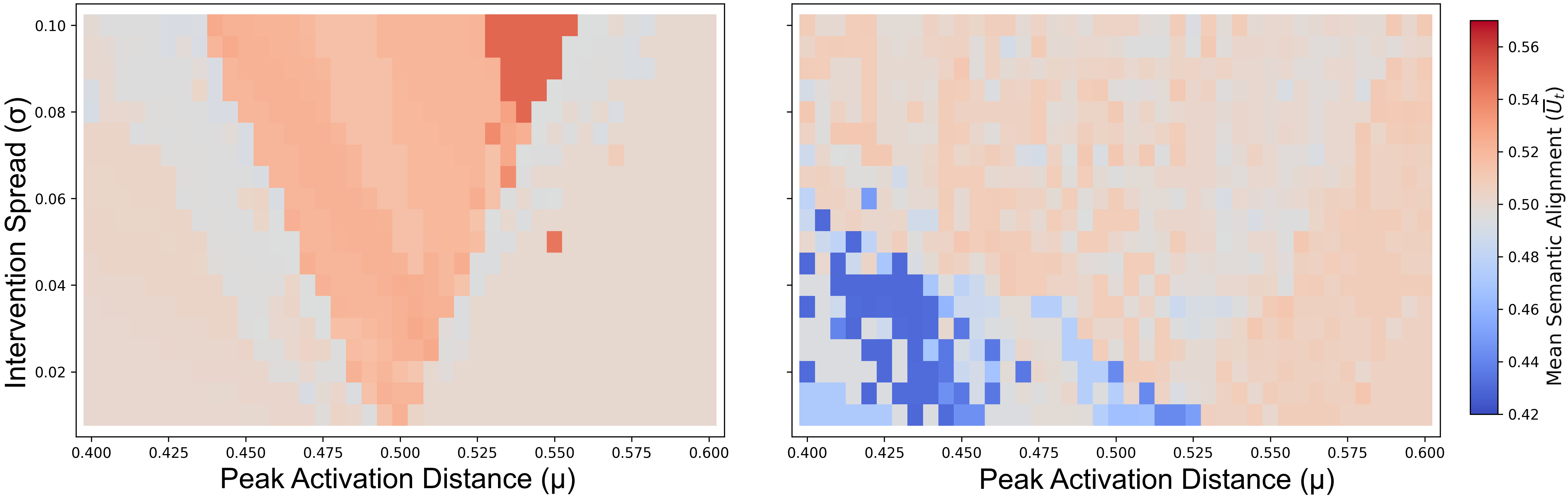
(a) Happy → Computer, α=15.0
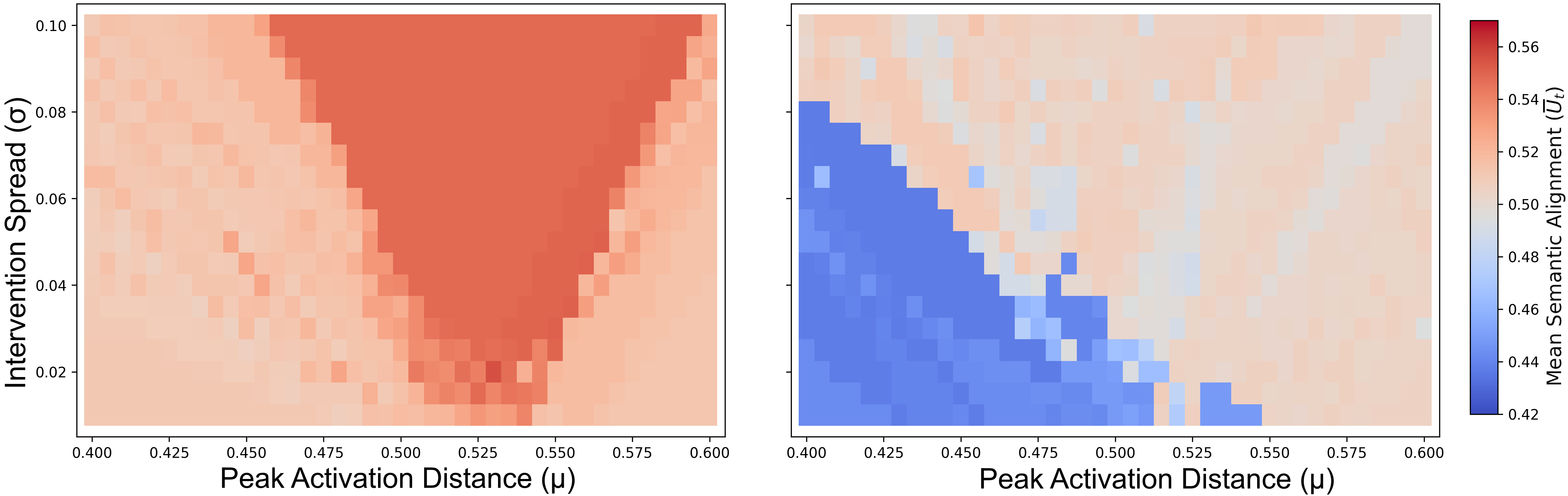
(b) Brain → Symphony, α=30.0
Figure 1 Macroscopic phase diagrams of mean semantic potential (Ut) across exploratory substrates under varying task constraints. (a) presents the low-affinity Happy → Computer blend under mild coupling (α = 15.0), and (b) presents the high-affinity Brain → Symphony blend under increased coupling (α = 30.0). The left panels display Llama-3.1-8B exhibiting high manifold elasticity, forming a smooth, V-shaped ``Habitable Ridge'' of sustained potential. The right panels display Gemma-7B exhibiting rigid crystalline deflection at weaker intervention (a-right), with sharp structural breaches appearing only under stronger intervention (b-right).
- Manifold Elasticity: Under a mild coupling strength ($\alpha = 15.0$), Llama-8B yields smoothly, allowing the autoregressive trajectory to bend into a highly stable, continuous, V-shaped Habitable Ridge (as visualized in the macroscopic phase diagrams).
- Response to Over-steering: Under stronger intervention, Llama often transitions from the habitable regime into Semantic Crystallization (repetitive loops) rather than immediate syntactic disintegration.
- Possible Contributing Factors: Llama-3.1-8B has a vocabulary of roughly 128k tokens. Vocabulary size, tokenizer design, architecture, pre-training distribution, and other factors may all contribute to the observed flexibility; the present experiments do not isolate their individual causal effects.
💎 Gemma-7B: The Rigid Crystalline Substrate
In stark contrast, Gemma-7B behaves as an extremely rigid, brittle crystalline substrate. It actively resists external forces until its topological limits are breached, resulting in catastrophic failure.
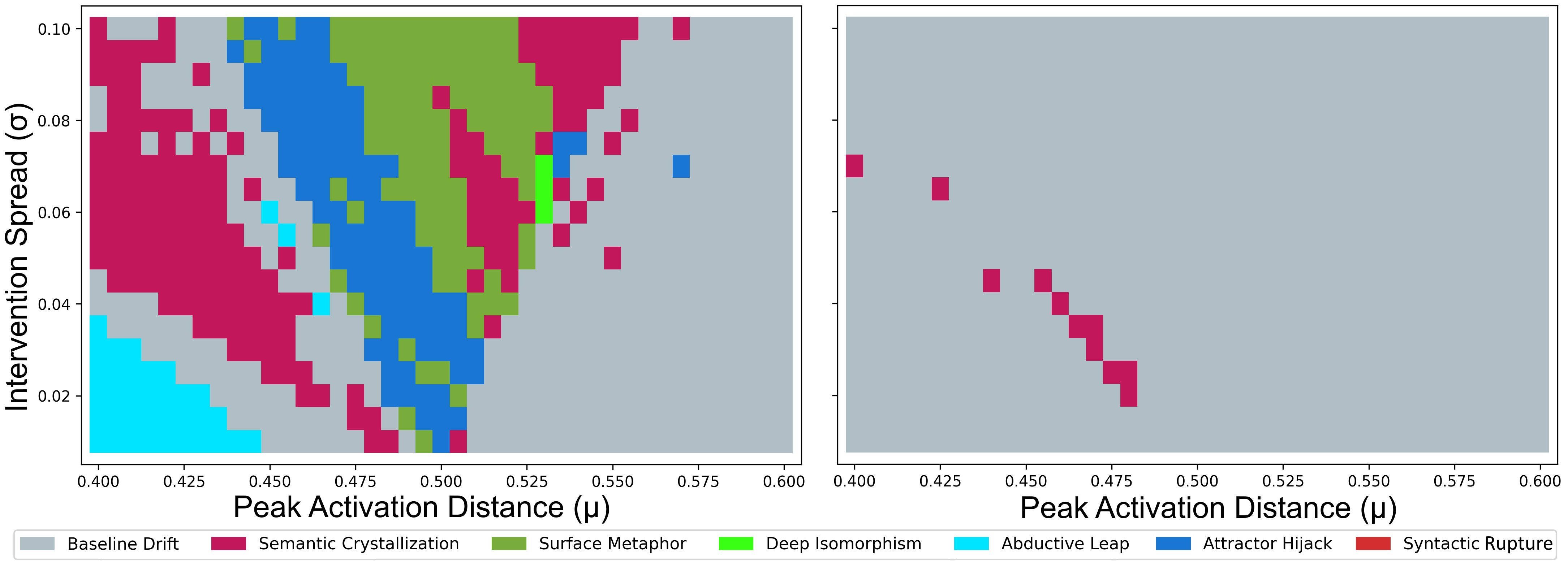
Figure 2 Emergent phenotype matrices mapping the spatial self-organization of trajectories for the Happy → Computer task under α = 15.0. The left panel (Llama-3.1-8B) illustrates high elastic habitability, featuring a structured band of stable Homeostatic Solitons (green) along the Habitable Ridge, bounded by Attractor Hijacks (blue). The right panel (Gemma-7B) displays crystalline rigidity, where the external intervention force is completely deflected, leaving the system entirely within the unsteered baseline drift (gray).
- The Inertial Barrier: Under mild coupling ($\alpha = 15.0$), Gemma’s rigid crystalline shell completely deflects the external semantic force. The steering trajectory is absorbed by the model’s massive contextual gravity, remaining trapped in the baseline drift regime.
- Abrupt Structural Fracture: Gemma does not possess a smooth, plastic transition zone. If the intervention strength is increased to overcome this Inertial Barrier, the model resists up to a critical threshold, past which it abruptly fractures. This manifests phenomenologically as an immediate transition from baseline drift into complete Syntactic Rupture (the structural disintegration of natural language into garbled token streams like “Data Data Data NN Data”).
- Possible Vocabulary Contribution: Gemma-7B has a substantially larger vocabulary (~256k tokens). Vocabulary size may contribute to the observed response geometry, but this comparison is confounded by tokenizer design, architecture, training distribution, and other model-specific factors. We therefore treat vocabulary size as a hypothesis to be tested rather than as the established cause of rigidity.
📊 Mapping the Topological Contrast
Our 779-point grid sweeps capture this material dichotomy with high quantitative precision.
| Material Characteristic | Meta-Llama-3.1-8B | Gemma-7B |
|---|---|---|
| Substrate Type | Elastic (Rubber-like) | Brittle (Crystalline) |
| Vocabulary Size | ~128k tokens | ~256k tokens |
| Habitable Ridge Geometry | Smooth, Continuous, V-shaped | Highly Fragmented / Brittle Breaches |
| Response to Over-steering | Gentle decay into Crystallization | Abrupt fracture into Syntactic Rupture |
| Primary Steering Barrier | Weak semantic gravity | High-inertia Crystalline Shield |
These findings suggest that Semantic Lenia can also serve as a dynamical probe for characterizing substrate-dependent responses to non-linear semantic intervention. The observed contrasts motivate a broader investigation of how model architecture, tokenizer design, vocabulary, and training history shape the geometry and stability of homeostatic trajectory regimes.