Phase Diagram & Taxonomy
🏠 Home • Phase Diagram • Dashboard • Substrate Rigidity • Lifespan & Aging • Gallery • Datasets • Roadmap
Phase Diagram & Taxonomy
To map the geometric landscape of machine cognition under non-linear steering, we perform high-resolution $(\mu, \sigma)$ parameter sweeps. This page explains the resulting phase diagrams and provides a mathematical taxonomy of the self-organizing trajectories.
🗺️ Macroscopic Interactive Phase Diagram
Under mild intervention strength ($\alpha=15$) on our exploratory substrate (Meta-Llama-3.1-8B), the measured trajectories exhibit a smooth, V-shaped “Habitable Ridge” in $(\mu,\sigma)$ space. Within this region, the state-dependent feedback supports bounded Homeostatic Soliton regimes over the observed generation horizon. Here is the interactive phase diagram extracted from our grid sweeps of 779 individual simulation points:
↗️ Open Phase Diagram in Full Screen
Figure 2-(Left): Emergent phenotype matrices mapping the spatial self-organization of trajectories for the Happy → Computer task under α = 15. Llama-3.1-8B illustrates high elastic habitability, featuring a structured band of stable Homeostatic Solitons (green) along the Habitable Ridge, bounded by Attractor Hijacks (blue).
🧬 Taxonomy of Emergent Phenotypes
To provide a reproducible operational taxonomy, we use a hybrid classification pipeline combining LLM-as-a-Judge semantic evaluation with trajectory-level diagnostics. Semantic phenotype families are assigned from the generated text, while very low sampled-token variability is used as an empirical indicator of Semantic Crystallization. The public taxonomy contains six macroscopic phenotype families; Homeostatic Soliton is further divided into the internal subtypes Deep Isomorphism and Surface Metaphor.
For historical continuity with the manuscript and released datasets, we retain the symbol Perplexity Variance. Operationally, however, the per-step quantity is the inverse probability of the sampled token under the temperature-scaled, already-steered next-token distribution:
\[PPL_t = \frac{1}{p(w_t)}\]where $p(w_t)$ is the probability of the token actually sampled at step $t$ after Semantic Lenia intervention and temperature scaling. Thus, $PPL_t$ is an instantaneous sampled-token inverse probability, not conventional sequence perplexity computed from mean negative log-likelihood.
\[PPL_{\text{var}} = \frac{1}{T} \sum_{t=1}^T (PPL_t - \overline{PPL})^2 \quad (\text{Eq. 7})\]In our classification dataset, $PPL_{\text{var}} < 10.0$ was empirically associated with low-variability repetitive trajectories. This threshold is an operational classifier boundary, not a direct measurement of Shannon entropy and not a universal perplexity threshold.
- Baseline Drift: $\bar U_t < \mu-\Delta$, $PPL_{var} \geq 10.0$
- Homeostatic Soliton: $\mu-\Delta \leq \bar U_t \leq \mu+\Delta$, $PPL_{var} \geq 10.0$ (bounded recurrent / chaotic-like regime)
- Abductive Leap: Escape ($\bar U_t < \mu-\Delta $), $PPL_{var} \geq 10.0$ (slingshot-like transition into a third-party semantic domain)
- Attractor Hijack: $\bar U_t > \mu+\Delta $, $PPL_{var} \geq 10.0$ (Domain Collapse)
- Semantic Crystallization: asymptotically low $PPL_{var}$ with repetitive token looping (low-variability repetitive regime)
- Syntactic Rupture: Grammatical Rupture
🦋 Hardware-Level Reproducibility at the Edge of Chaos
Small numerical differences associated with NVIDIA Ampere (RTX 3090) and Blackwell (RTX Pro 4500) GPU architectures can lead to macroscopic token-sequence divergence under otherwise matched settings. Across the 779-point sweep, these hardware-sensitive divergences concentrate near the boundaries of the V-shaped Habitable Ridge. We interpret this spatial concentration as evidence of enhanced perturbation sensitivity in a critical regime, consistent with—but not by itself proving—an edge-of-chaos interpretation.
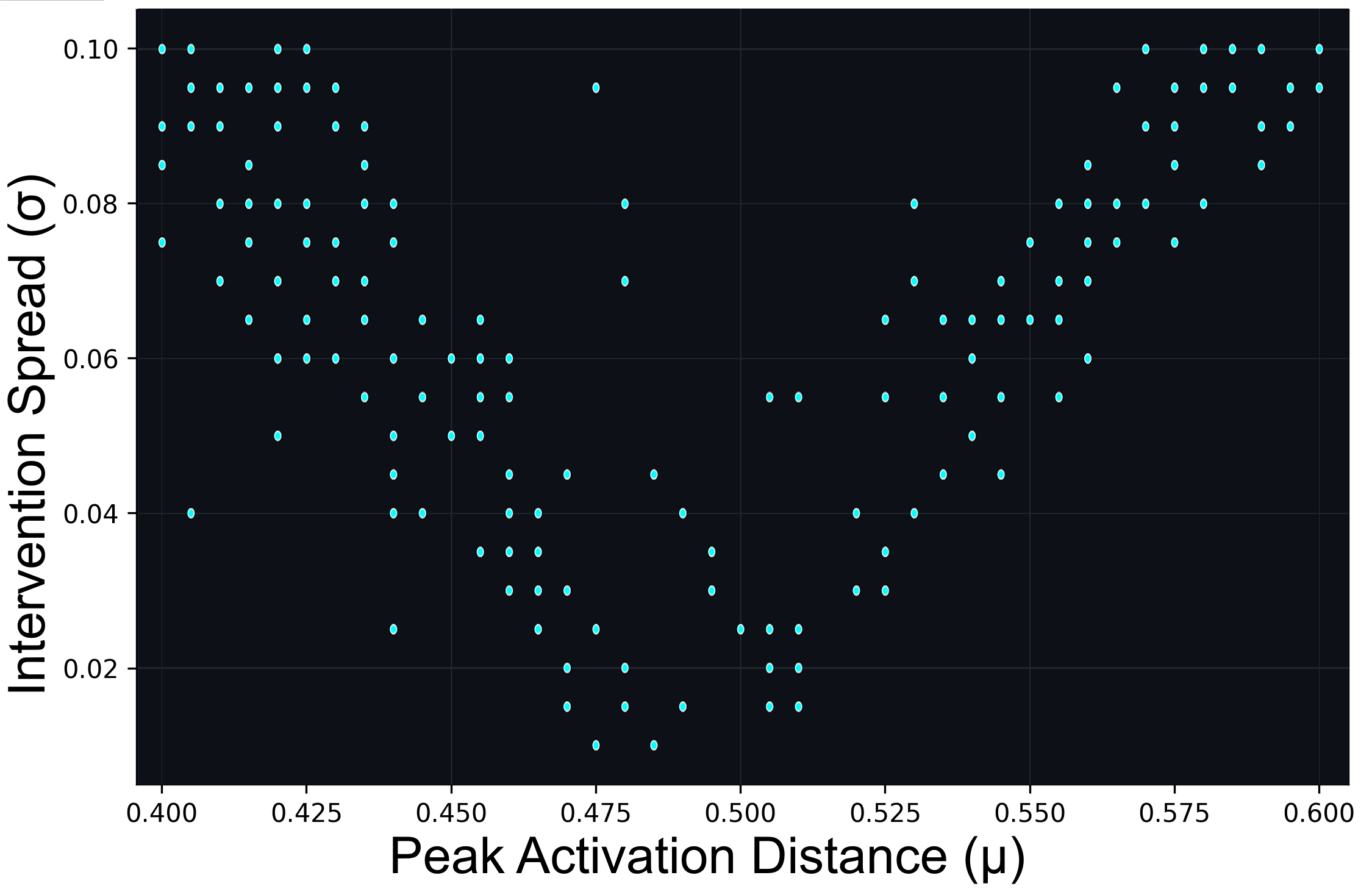
Figure 4: Spatial distribution of hardware-induced trajectory bifurcations (Llama-3.1-8B, Happy → Computer, α = 15.0). Each plotted point represents a parameter coordinate where infinitesimal FP16 rounding errors (10-4) between Blackwell and Ampere GPU architectures cause identical initial states to diverge into distinct text paths. The distribution closely follows the boundaries of the V-shaped ``Habitable Ridge'' mapped in Figure 2-(Left), with a visibly thicker divergence band along the left boundary (lower μ), consistent with the asymmetric structure of the intervention field.